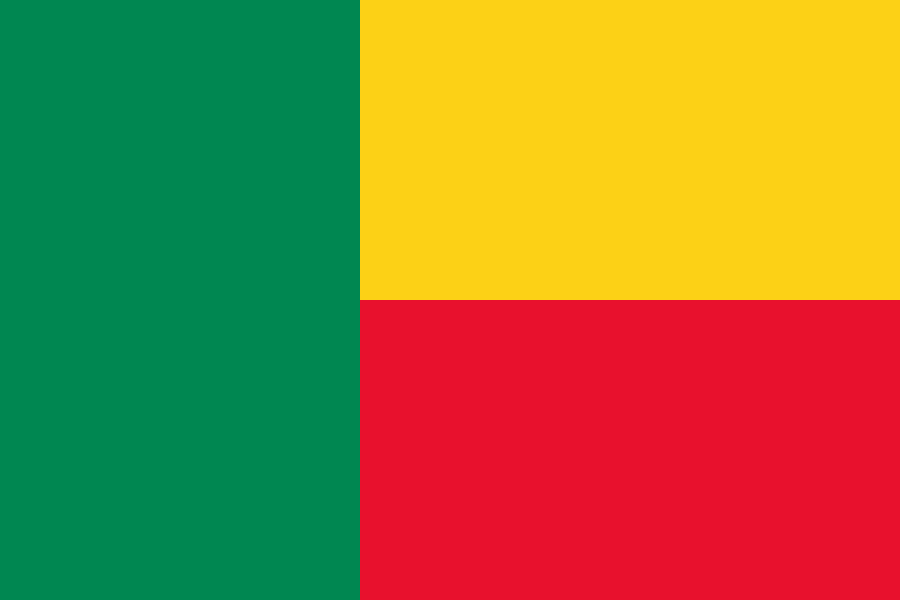
West Africa
Benin
Republic of Benin
- Capital
- Porto-Novo
- Independence
- 1960-08-01
Benin became independent in 1960 as the Republic of Dahomey and went through a dozen years of coups and short-lived governments driven by regional rivalries. Mathieu Kérékou seized power in 1972 and ran a Marxist-Leninist one-party state until a 1990 National Conference opened the way to multi-party democracy. Power then changed hands at the ballot box several times, although political competition narrowed sharply under Patrice Talon after 2016. Romuald Wadagni succeeded Talon in 2026.
No overview written for this section yet.
No overview written for this section yet.
Political timeline 52
-
Romuald Wadagni elected
Romuald Wadagni, President
Finance minister Romuald Wadagni, Talon's chosen successor and the candidate of both ruling parties, won by a landslide over Paul Hounkpè, who conceded. The Democrats were unable to field a candidate. Wadagni was sworn in on 24 May 2026 for a seven-year term, with Mariam Chabi Talata as vice president.
-
Parliamentary election
Only the two parties allied to the president passed the threshold of 20% in every constituency. The opposition Democrats lost all their seats, and turnout was about 37%.
-
Failed coup against Talon
Soldiers led by Lieutenant Colonel Pascal Tigri appeared on state television to announce that Talon had been removed. Loyal forces regained control the same day with support from Nigerian aircraft and troops, and ECOWAS deployed elements of its standby force.
-
Seven-year terms and a Senate
The National Assembly voted 90 to 19 for a constitutional revision that lengthened presidential and parliamentary terms from five to seven years and created a partly appointed Senate. The two-term limit for presidents was kept. The Constitutional Court validated the text and Talon promulgated it on 17 December 2025.
-
Alleged coup plot
Businessman Olivier Boko, long a close associate of Talon, and former sports minister Oswald Homéky were arrested and accused of trying to bribe the head of the Republican Guard to stage a coup. Both were sentenced to 20 years in prison in January 2025.
-
Parliamentary election
The opposition returned to parliament when The Democrats, the party linked to former President Boni Yayi, won 28 seats. The two pro-Talon parties kept a clear majority.
-
Talon re-elected
Patrice Talon, President
Talon won a second term with Mariam Chabi Talata as vice president. Most prominent opposition figures were in exile, in prison or unable to obtain the required sponsorships, and there were deadly protests in the centre of the country before the vote.
-
Constitutional amendment
The all-loyalist National Assembly adopted the first amendment to the 1990 constitution. It created the post of vice president, aligned the electoral calendar, and required presidential candidates to be sponsored by elected officials.
-
Parliamentary election without the opposition
New electoral rules left only two parties, both allied to Talon, able to stand. Turnout fell to a record low, and protests in Cotonou in the following days were put down with deadly force.
-
Patrice Talon elected
Patrice Talon, President
The businessman Patrice Talon defeated Prime Minister Lionel Zinsou, the candidate backed by outgoing President Boni Yayi, after a first round on 6 March. Zinsou conceded on election night.
-
Parliamentary election
FCBE remained the largest group but lost ground. Opposition leader Adrien Houngbédji was elected speaker, which ended speculation about a constitutional change to allow Boni Yayi a third term.
-
Parliamentary election
The president's FCBE alliance won just under half of the seats and governed with allied parties.
-
Boni Yayi re-elected
Thomas Boni Yayi, President
Boni Yayi won in the first round against Adrien Houngbédji, the first such win since 1991. The vote had been postponed twice because of problems with a new electronic voter roll, and Houngbédji disputed the result.
-
Parliamentary election
The Cowry Forces for an Emerging Benin (FCBE), the alliance supporting Boni Yayi, became the largest group in the National Assembly.
-
Boni Yayi elected
Thomas Boni Yayi, President
Kérékou and Soglo were both barred by the constitutional age limit, and Kérékou respected the two-term limit. Thomas Boni Yayi, a banker and political newcomer, beat Adrien Houngbédji in the second round after a first round on 5 March.
-
Parliamentary election
Parties supporting Kérékou gained a parliamentary majority for the first time since the return to multi-party politics.
-
Kérékou re-elected
Mathieu Kérékou, President
After the first round on 4 March, Soglo and Houngbédji withdrew from the runoff and alleged fraud. Kérékou faced Bruno Amoussou, one of his own ministers, and won easily.
-
Parliamentary election
Opposition parties led by Soglo's Renaissance du Bénin won a slim majority over the parties supporting Kérékou.
-
Kérékou returns through the ballot box
Mathieu Kérékou, President
Kérékou, backed by third-placed Adrien Houngbédji, defeated President Soglo in the second round. Soglo alleged fraud but stepped down after the Constitutional Court confirmed the result.
-
Parliamentary election
Soglo's Renaissance du Bénin became the largest single party, but parties opposed to the president together held more seats.
-
Soglo defeats Kérékou
Nicéphore Soglo, President
Nicéphore Soglo beat Kérékou in the second round after a first round on 10 March. Kérékou accepted defeat, which made Benin one of the first countries in mainland Africa where an incumbent ruler was voted out.
-
First multi-party parliamentary election
Many parties and alliances won seats in a fragmented National Assembly. The coalition backing Prime Minister Soglo was the largest group.
-
Multi-party constitution approved
A referendum approved a new constitution with a presidential system, multi-party politics and a limit of two five-year presidential terms.
-
National Conference
The National Conference of Active Forces of the Nation met in Cotonou from 19 to 28 February, declared itself sovereign and suspended the constitution. It chose Nicéphore Soglo as transitional prime minister, with Kérékou staying on as president with reduced powers. The country was renamed the Republic of Benin on 1 March 1990.
-
Marxism-Leninism abandoned
Under pressure from strikes, unpaid civil servants and foreign creditors, Kérékou announced that Marxism-Leninism was no longer the state ideology. He agreed to convene a national conference of all political forces.
-
Last one-party parliamentary election
Mathieu Kérékou, President
The final single-list election took place during a banking collapse and months of strikes. The assembly re-elected Kérékou in August 1989.
-
Foiled army plot
The government announced that it had foiled a coup plot by army officers, and a number of soldiers were arrested. It came as the economy collapsed and the state struggled to pay salaries.
-
One-party parliamentary election
Mathieu Kérékou, President
A single list was again put to voters. The new assembly re-elected Kérékou president on 31 July 1984.
-
One-party parliamentary election
Mathieu Kérékou, President
Voters approved a single list of candidates for the National Revolutionary Assembly. The assembly elected Kérékou president in February 1980.
-
Fundamental Law adopted
A new basic law formalised the one-party socialist state and created a National Revolutionary Assembly whose members would be elected on a single PRPB list.
-
Mercenary raid on Cotonou
A force of mercenaries led by the Frenchman Bob Denard landed at Cotonou airport and attacked the presidential palace. The raid was repelled within hours and the attackers flew out.
-
People's Republic of Benin proclaimed
Mathieu Kérékou, President
Dahomey was renamed the People's Republic of Benin. The People's Revolutionary Party of Benin (PRPB) was founded as the sole legal party.
-
Assogba plot
Captain Janvier Assogba, the labour minister, attempted to mobilise troops against Kérékou and was arrested. A few months later, in June 1975, interior minister Michel Aikpé was shot dead in disputed circumstances, which set off protests.
-
Marxism-Leninism declared the state ideology
In a speech at Abomey, Kérékou announced that Dahomey would follow Marxism-Leninism. Banks, insurance and the oil distribution sector were nationalised in the following months.
-
Kérékou seizes power
Mathieu Kérékou, President
Major Mathieu Kérékou overthrew the Presidential Council and jailed its three members. He formed a Military Revolutionary Government and ended the cycle of regional three-way rivalry.
-
Ahomadégbé takes over the Presidential Council
Justin Ahomadégbé-Tomêtin, Chairman of the Presidential Council
Maga handed the chairmanship to Justin Ahomadégbé-Tomêtin as scheduled. It was one of the few peaceful transfers of power in the country's early history.
-
Failed coup at Ouidah
Soldiers linked to Kouandété mutinied and tried to kill army chief Paul-Émile de Souza. The plot failed and Kouandété was later sentenced to death, although the sentence was never carried out.
-
Presidential Council installed
Hubert Maga, Chairman of the Presidential Council
As a compromise, Maga, Ahomadégbé and Apithy formed a Presidential Council whose chairmanship was to rotate every two years. Maga took the first turn.
-
Presidential election abandoned
Voting was held region by region during March, with Maga, Apithy, Ahomadégbé and Zinsou competing. Violence and fraud claims led the Military Directorate to halt the vote and cancel the result, and the country came close to splitting along regional lines.
-
Kouandété overthrows Zinsou
Paul-Émile de Souza, Chairman of the Military Directorate
Kouandété, by then army chief of staff, removed Zinsou. The army did not accept Kouandété as leader, and on 13 December a three-man Military Directorate chaired by Lieutenant Colonel Paul-Émile de Souza took charge.
-
Military appoints Émile Derlin Zinsou
Émile Derlin Zinsou, President
The officers handed the presidency to Émile Derlin Zinsou, a civilian doctor and former foreign minister. His appointment was endorsed by a referendum on 28 July 1968.
-
Presidential election annulled
The military barred all former presidents and vice presidents from standing, and they called a boycott. The little-known Basile Adjou Moumouni won easily, but only about a quarter of voters took part and the army annulled the result.
-
Constitutional referendum
Voters approved a new presidential constitution prepared under the military government.
-
Alphonse Alley becomes head of state
Alphonse Alley, Head of State
Lieutenant Colonel Alphonse Alley, the army chief of staff, was installed as head of state, with Kouandété as head of government. The officers promised a new constitution and a handover to civilians within six months.
-
Young officers overthrow Soglo
Maurice Kouandété, Head of the Provisional Government
A group of junior officers led by Major Maurice Kouandété deposed Soglo after a wave of strikes. Kouandété headed the government for only a few days because he lacked support within the army.
-
Soglo takes power
Christophe Soglo, President
When Congacou failed to organise new elections, Soglo dismissed him, suspended the constitution and banned political parties. He ruled as president at the head of a military and technocratic government for two years.
-
Apithy and Ahomadégbé forced to resign
Tahirou Congacou, Acting President
A deadlock between President Apithy and Vice President Ahomadégbé paralysed the government. General Soglo forced both men to resign, and the president of the National Assembly, Tahirou Congacou, formed an interim government.
-
General election
Sourou-Migan Apithy, President
The Dahomeyan Democratic Party was the only list on the ballot. Sourou-Migan Apithy became president and Justin Ahomadégbé-Tomêtin vice president and head of government, and Soglo handed power to them later in January.
-
Constitutional referendum
Voters approved a new constitution that created a two-headed executive, with a president as head of state and a vice president as head of government.
-
Army removes Maga
Christophe Soglo, Head of the Provisional Government
After days of strikes and demonstrations by trade unions and students, army chief Colonel Christophe Soglo took power and dissolved the government. He headed a provisional government that included the three main regional leaders and promised a return to civilian rule.
-
First general election
Hubert Maga, President
Maga was elected president with Apithy as vice president. Their Dahomeyan Unity Party took every seat in the National Assembly under a winner-takes-all list system, and it soon became the only legal party.
-
Independence from France
Hubert Maga, President
The Republic of Dahomey became independent from France with Hubert Maga, the northern leader and head of the pre-independence government, as head of state. Politics was dominated by three regional leaders: Maga in the north, Sourou-Migan Apithy in the south-east and Justin Ahomadégbé-Tomêtin in the south-west.
No overview written for this section yet.
No overview written for this section yet.
No overview written for this section yet.
No overview written for this section yet.
No overview written for this section yet.